
Public Lecture
Pushed by Sound: Moving Objects Too Small to See
David Goldhaber-Gordon
Stanford University
Wed, Jul 15, 5:30–6:30pm
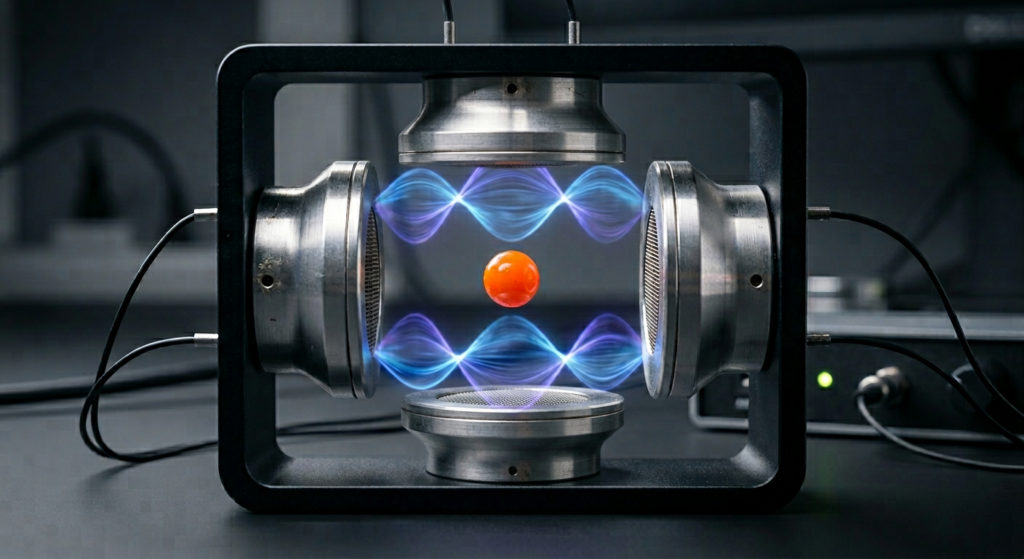
Sound is more than something you hear: it’s a physical force that can push, pull, and even levitate objects. In this talk, I’ll explain how scientists and engineers use sound waves to move things too small to see with the naked eye.
I’ll start with something almost magical: sound waves powerful enough to float a plastic ball in mid-air, suspending it against gravity using nothing but vibrations. From there, I’ll introduce you to the world of microfluidics, where sound is used to sort and steer living cells with remarkable precision through channels narrower than a human hair.
Finally, I’ll tell you how surface acoustic waves, vibrations that ripple across a solid surface, play an essential role in your cell phone. In my own lab we’ve discovered how to use them to slide ultra-thin sheets of material along a surface. Rotating or stretching such sheets could unlock new electrical, magnetic, and optical material properties.

About David Goldhaber-Gordon
David Goldhaber-Gordon is a physicist whose research studies and manipulates how electrons organize and flow on the nanoscale. In this regime, quantum effects and electron interactions are important, confounding intuitions gleaned from larger-scale electronics. Lately David and his research group have been excited about using a new class of materials called topological insulators to build 1D wires whose resistance does not increase with length; gaining insights into complex materials by designing “quantum simulators” based on electrons in well-controlled nanostructures; and engineering electronic properties by stacking atomically-thin materials. David also explores how nanostructured materials can change our thinking on electronic devices and energy conversion technology. He has been elected a Fellow of the American Physical Society and the American Association for the Advancement of Science, and has been recognized with the National Academy of Science Award for Initiatives in Research, the William McMillan Award, and the George E. Valley Prize of the American Physical Society.
Heinz R. Pagels Public Lecture Series
Heinz R Pagels was a professor of physics at Rockefeller University, president of the New York Academy of Science, a trustee of the Aspen Institute, and a member of the Aspen Center for Physics for twenty years, serving as a participant, officer, and trustee. He was also President of the International League for Human Rights. His work on chaos theory inspired the character of Ian Malcolm in the Jurassic Park book and movies. A part-time local resident, Professor Pagels died here in a mountaineering accident in 1988. His family and friends instituted the lecture series in his honor because he devoted a substantial part of his life to effective public dissemination of scientific knowledge.