
Public Lecture
How Cells Discover Their World
Andrew Mugler
University of Pittsburgh
Wed, Aug 12, 5:30–6:30pm
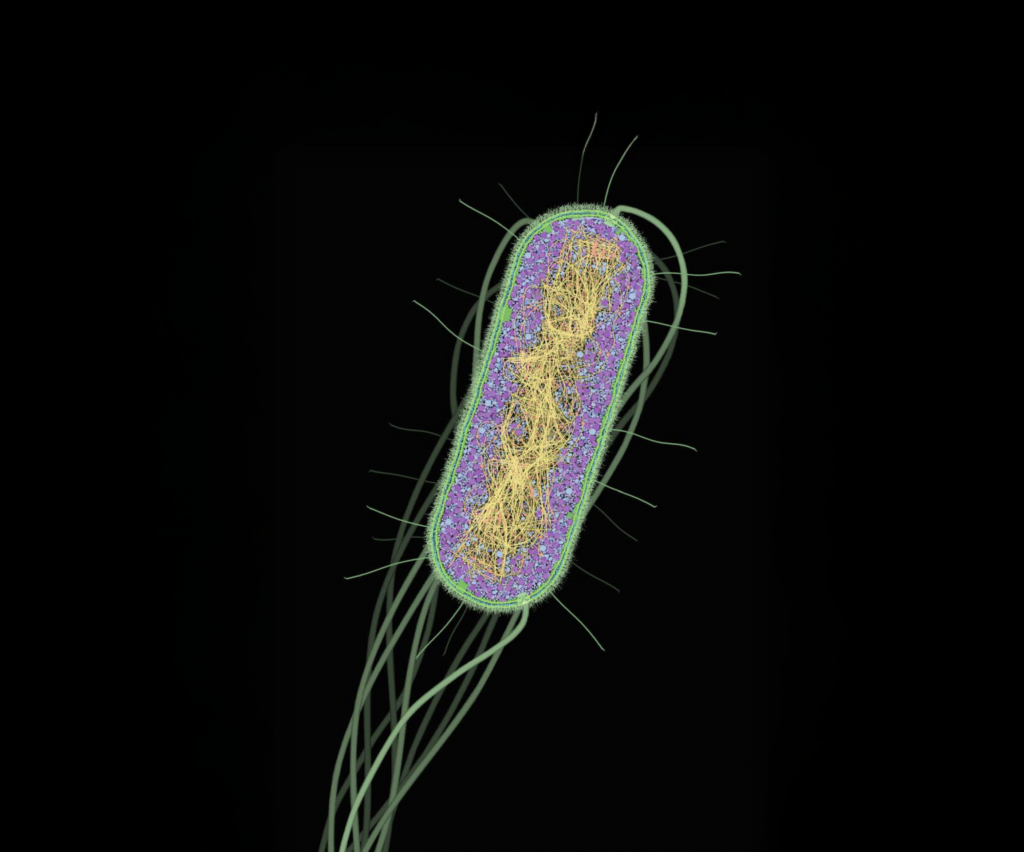
If you shrunk to the size of a single cell, the world would be unrecognizable. You might be in water, but swimming would get you nowhere. There might be food around, but reaching would push it further away. And you would not have a brain — after all, brains are billions of cells, but you would be just one cell. And yet, single cells have devised ingenious ways of discovering, interacting with, and thriving within their world. In this lecture, I will describe new ways of moving, eating, and thinking that are unfamiliar to us but work just fine at the scale of a cell. I will discuss how basic physics constrains these ways of living, and how cells can get around these constraints by joining together into multicellular groups. Cell-scale physics reveals the ingenuity of evolution and offers a new perspective on survival, disease, and the transition to multicellular life.
*Illustration by David S. Goodsell, from The Machinery of Life (Springer).

About Andrew Mugler
Andrew Mugler received his PhD in Physics at Columbia University in 2010 and held postdoctoral positions at AMOLF and Emory University before beginning his faculty position at Purdue University. In 2020, he moved to the University of Pittsburgh, where he leads a theory group focusing on the physics of cell sensing, cell growth, and microbial ecology. He was a Simons Investigator in the Mathematical Modeling of Living Systems and has received the NSF CAREER Award and the NIH MIRA Award. He directs the Artist in Residence program at the University of Pittsburgh and is an Advocacy Champion for the American Physical Society.
Heinz R. Pagels Public Lecture Series
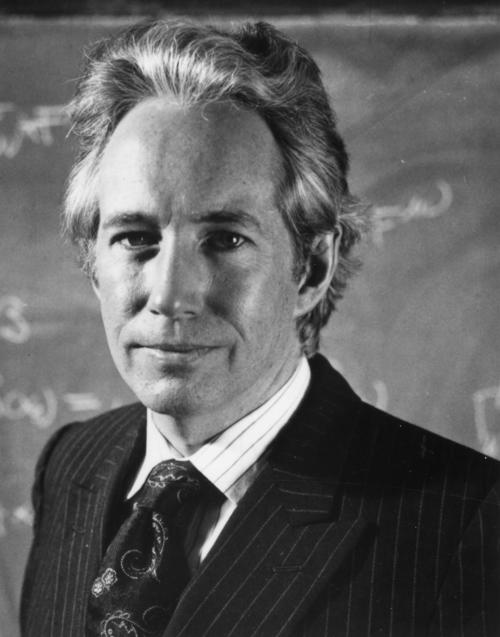
Heinz R Pagels was a professor of physics at Rockefeller University, president of the New York Academy of Science, a trustee of the Aspen Institute, and a member of the Aspen Center for Physics for twenty years, serving as a participant, officer, and trustee. He was also President of the International League for Human Rights. His work on chaos theory inspired the character of Ian Malcolm in the Jurassic Park book and movies. A part-time local resident, Professor Pagels died here in a mountaineering accident in 1988. His family and friends instituted the lecture series in his honor because he devoted a substantial part of his life to effective public dissemination of scientific knowledge.